Thursday, August 5, 2010

The South African Coast

Our original plan was to fly back to Johannesburg and then bus it to Nelspruit and head into Kruger National Park. From there we would head into Mozambique. However, after talking with a few other travelers, it became apparent that travel in Mozambique is slow going and difficult and we would not have sufficient time to really explore the areas we wanted to see. Instead, we decided to keep our car rental for the month and travel the coast.


The first stop was Hermanus. Hermanus is known as a top spot for seeing whales during season. Luckily we were there during the season. We grabbed a table at a café on the water and while enjoying lunch, watched the Southern Right Whales in the bay.

We didn’t stay long in Hermanus, but it did occur to me that the teens of the area must be more mature than U.S. teens as I did not spot a single missing “m” on any of the town’s signs.

From Hermanus, we joined up with the “Garden Route.” It was definitely low season and things were quiet. It was quite a nice scenic drive, but I think we are just not scenic drive people. We spent a night in Knysna, which was a quaint little town, but again things were almost too quiet.


Eventually we drove inland a bit to the Addo Elephant National Park. This was our first game viewing opportunity and we were excited for it! We stayed outside the park at a cool place called Avoca. The folks there were incredibly nice and they gave us a full chalet for the price of their cheapest hut.


The area was beautiful and the park didn’t disappoint. The park is known for – you guessed it! – elephants, and we saw many. We also saw hyena, buffalo, tons of antelope and vervet monkeys.


After Addo, we headed onto the “Wild Coast.” We thought it was given this name due to the rough coastal landscape. While that is partly true we learned it is also due to the fact that the area was never really brought under control during Apartheid. As such the villages and culture of the region seem more intact than other places we had been in South Africa.


One of the coolest spots we visited was Coffee Bay. A little over a decade ago, some surfers approached the Xhosa village at Coffee Bay about opening a hostel (the "X" in Xhosa represents a type of click made by the tongue on the side of the mouth). The hostel is a joint venture of sorts between the surfers and the Xhosa people. Many of the local villagers work at the hostel and they take pride in the hostel, their role in it and their village overall.


We were welcomed, as they do once per week, to the “head man’s” home in the village for dinner and dancing. The “mamas” served us a great traditional meal of samp and beans along with their traditional home brewed beer. We sat around (with women on the floor and men seated in the Xhosa style) and chatted for a while with one of the Xhosa from the hostel serving as interpreter as many of the villagers don’t speak English. However, it wasn’t long before the music started and we all began to dance.


The village was definitely an interesting experience as old ways meet modern life. The women still put on traditional costumes for these events, though the customary red shirt is often now a T-shirt. The village has no electricity in the mud and thatched huts, but they do have a cell phone tower (they say keeping the phones charged is the biggest problem).


Unfortunately, I was not doing so well by this point as I had acquired some food poisoning. We’re pretty sure I got it from a fast food restaurant on the N2 Highway of the Garden Route as that is the only recent time Leslie and I ate separate meals. I ended up spending much of the next day in bed and missed my chance to go surfing.

Leslie did head out and spent time in the village. The locals all hang out by the water selling beadwear and Leslie bought some beads from Martha and Mbumba after chatting for a long while.


It was the weekend so the kids were out playing on the beach and Leslie fit right in! The place is so serene and beautiful, but the real treat was seeing how the village, the local surfing community and the travelers all seem to work so well together -- not always the case in South Africa.


We had planned to make the long drive to Durban next, but the folks at Coffee Bay suggested we stop about 100 KM south at a place called the Mantis & Moon Hostel. We took their advice and were glad we did. We met a bunch of nice folks and two – an Englishman named Charlie and an American named Trevor – hitched a ride with us the next day further up the coast. We dropped Charlie in Durban and Trevor, who is living in South Africa and works at the Mantis & Moon, came with us all the way to St. Lucia.


St. Lucia is known for its wetlands and it was a beautiful spot. The hippos and crocs are abundant in the area and we saw many on a day hike the afternoon we arrived. We spent the next day hiking around and exploring while Trevor went to the Hluhluwe Umfolozi Game Reserve on a guided safari.


The next day we dropped Trevor at the bus station so he could head back to work while we headed north for the kingdom of Swaziland.

Read more...

Saturday, July 31, 2010

Stellenbosch and Franschhoek Wine Regions South Africa


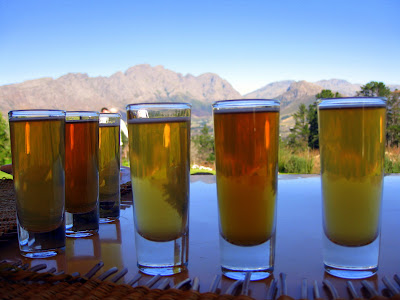
Stellenbosch is a small university town not too far from Cape Town and is the heart of the South Africa wine region. It seems that South African wines do not have the popularity of many other regions in the United States (even though they have been making wine here as far back as 1659). However, we can see this area becoming another wine "hot spot," particularly if you are a fan of red wines.


 We visited 9 wineries or farms as they call them here in South Africa. Our first farm was M'Hudi. While doing some research on South African wines, I found out that M'Hudi is the only black family owned vineyard in South Africa. I emailed M'Hudi about a tasting and got an email back from Diale (the viticulturist) and got a date set. We met with Diale (or more commonly known as Oupa (meaning Grandfather) at their house and farm and chatted for almost three hours about practically everything! From Africa, America, politics, sports and of course wine! Oupa and Raymond (Oupa's daugther's husband's father... I think I got that right! Who also is also apart of this family affair winery) were fantastically friendly and funny. Oupa is super unpretentious. I had said that the Sauvignon Blanc had a green apple smell and Oupa laughed and said, "Really? I don't really know what a green apple smells like. I think there is more of a hint of cat piss! Though my wife would kill me if she heard me say that." Ha! It is true with a lot of South African wines, it has that minerally cat pee smell that sounds weird but totally works in a Sauvignon Blanc!


Also their two grandsons were running around the yard and on their bikes. We really felt welcomed and almost like a family member just having wine on the back porch. We loved the wine and bought a bottle of the Pinotage and Merlot. Their pinotage has a real smokiness up front that then reveals dark fruits on the back end. Also their Merlot has old world characteristics and was really full bodied. We had to explain to Oupa that not every American hates Merlot post Sideways (a movie he has heard about but not seen!)


There are generally three things we judge a winery visit on: 1. Of course the wine; 2. How welcoming the the winery staff/tour is and finally 3. The location. M'Hudi has to be our favorite winery we have visited on this whole trip!

We also went to a few other wineries too! We headed to Thelema's beautiful farm where we had some pretty great reds including a really good Cabernet which is really dry but nice deep coffee flavors. I also loved it that they had a really cool dalmatian!


We then were at the super slick Tokara tasting room. Tokara has a beautiful view out their tasting room. More fantastic wines and great olives as well.


We ended our day in Stellenbosch with Glenelly Estate. This is a newer farm and owned by May de Lencquesaing, owner of Chateau Pichon Longueville Comtesse de Lalande in France. We had a fantastic personal tour of their new "green" building. The bottles are beautiful with one of May de Lencquesaing's glass collection on the bottle.


The next day we headed to Franschhoek which is supposedly the "Napa" like area of South Africa with tons of hip restaurants and wineries. We started off at Dieu Donne for a tasting. They even had a brewery so Jim got to do a beer tasting as well. Dieu Donne has a fantastic view of the Franschhoek valley.


Just down the road from Dieu Donne is Chamonix which has a cool cellar that makes you feel like you are in the French countryside. We absolutely loved their Sauvignon Blanc Reserve 2008. It is fermented in French oak and it gives it a perfect wood/citrus taste.


We could not resist also Yonder Hill just for the picture...


We could have spent weeks here and still not made it to every winery (we did not even have time to make it to the town of Paarl!). Stellenbosch and Franschhoek are great wine regions and seemingly unpretentious people who just pour good wines. We are excited to try even more South African wines when we get home!


Read more...

Sunday, July 25, 2010

Cape Town, South Africa

Thirty-five hours of travel and we arrived in a different continent, climate and hemisphere for what certainly feels like the final stretch of our adventure - Africa!


Cape Town is our first stop in South Africa and and seemingly everyone from friends at home to fellow travelers we have met along the way, rave about Cape Town and it is easy to see why.

The "Mother City" is dramatically set against the Atlantic and framed by imposing Table Mountain, which is visible from almost anywhere in the city. We timed our visit to Cape Town to miss the World Cup (not that we don't like soccer - or as everyone outside of the states say "football" - but to hopefully avoid the expense that the World Cup brings). even though we were a week after the World Cup the city and the Country were still buzzing from it. Vendors are still out selling vuvuzelas and jerseys on every street.


We luckily arrived to sunny weather in Cape Town and so we quickly decided to hike up Table Mountain. We have done a lot of hikes on our trip and we felt that Table Mountain was a pretty awesome day hike. The panoramic views from the top look out to lighthouses lining the cape, the city and the Atlantic. It is a gorgeous view.


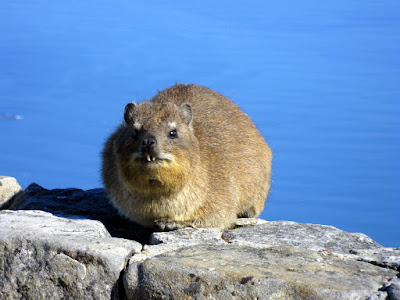
Ever present at the top of Table Mountain is the Rock Dassie which is literally Dutch for Badger. These guys have become used to people on Table Mountain and they seem to ham it up for the photographers. However we are still confused by the plaque on Table Mountain which claims that the elephant's closest relative is the Dassie?


Through Cape Town's beauty there is also an infamous past. We grew up with protests against South Africa due to apartheid and it is interesting to see how South Africa is progressing. However, issues still obviously exist and the echos of South Africa's recent past still linger. Outside of Cape Town (and seemingly a lot of the cities) are townships where people live in houses made of scrap iron and other found materials. The townships were originally where the government forcibly relocated blacks further from the city center. These townships still exist post apartheid and there are movements to revitalize them and bring basic services such as water and electricity to the homes. We went to the District Six museum in Cape Town to get some small feeling of the history.


District Six was the name of an inner city area of Cape Town which was a lively community in Cape Town made up of a number of different ethnic groups.

From Wikipedia:


On 11 February 1966, the government declared District Six a whites-only area under the Group Areas Act, with removals starting in 1968. By 1982, more than 60,000 people had been relocated to the sandy, bleak Cape Flats township complex some 25 kilometers away. The old houses were bulldozed. The only buildings left standing were places of worship.

While there have been attempts at reconciliation, there have been numerous roadblocks. The museum is really interesting and has pictures and stories of the people and families who lived in District Six. It also provides a history of what happened to the area and a memorial to the destruction of the community. It is a very moving museum and very much worth spending a long time reading about the people and the history.


On our last day in Cape Town, we rented a car and headed down to Cape Point which is said to be where the Atlantic and the Indian Oceans meet. It was pretty windy but clear for some great shots of the point.


There are signs everywhere that warn that baboons are dangerous and to not have any food out or they will steal it. Well as we were walking we saw a couple sit outside right next to the signs and eat a pizza. Well, sure enough a baboon mother and baby came out and stole their pizza! No eating outside!


We headed up the eastern side of the Cape to Simon's Town where we stopped at Boulder's Beach where hundreds of Penguins crowded in the bushes to rear their young. There is a deck built along the beach that allows you to get pretty close to the penguins.


We left Cape Town to head up to the wine regions and then up the coast. Cape Town is a beautiful city and a perfect start to seeing South Africa.


Read more...

Thursday, July 15, 2010

Beijing

Beijing – the north capital – or Peking… whatever you call it, it is immediately apparent that the city is very different than Shanghai and Hong Kong. Where Shanghai and Hong Kong have seemingly embraced the high-rise buildings, frenetic pace and commercialism we typically associate with cities of the west, Beijing seems positively laid back and quaint by comparison; almost as if from another era.


Though our first impression of Beijing was the modern airport and the even-more-modern airport express train to the city, we emerged from the subway station to a different world than we had become accustomed to in the previous weeks. There were no skyscrapers anywhere near us and though major roads and subways criss-cross the city, Beijing’s heart is in the hutongs that spread like a tapestry in the in-between spaces of the city.


Hutongs are, for lack of a better word, alleyways. But that really doesn’t do it justice. Hutongs represent a way of life for many of the people of Beijing. Close-knit families will share a typical hutong dwelling that are basically courtyard central homes. And many close-knit neighbors will share a hutong “alleyway.” Each one seems to represent a micro-community of its own.

Once again, I defer to Wikipedia:


Hutongs are a type of narrow streets or alleys, most commonly associated with Beijing, China. In Beijing, hutongs are alleys formed by lines of siheyuan, traditional courtyard residences. Many neighbourhoods were formed by joining one siheyuan to another to form a hutong, and then joining one hutong to another. The word hutong is also used to refer to such neighbourhoods.


Since the mid-20th century, the number of Beijing hutongs has dropped dramatically as they are demolished to make way for new roads and buildings. More recently, some hutongs have been designated as protected areas in an attempt to preserve this aspect of Chinese cultural history.

When we first arrived in Beijing we stayed in a hostel that was located in a hutong. Immediately, even though we were only short-term guests, we were made to feel a part of the family.

Beijing hospitality, though, showed itself even before that. As we came out of the subway after our ride from the airport, we got turned around and walked the wrong direction as we tried to find our hostel. Looking confused a local twenty-something on his bike asked if we were lost. We showed him on our map where we wanted to go and he quickly identified our mistake. He sent us off in our direction and he rode off in the opposite direction to join his friends to watch the World Cup match that had just begun. Three minutes later he came riding up behind us and said he thought we might still have trouble finding it and he wished to walk with us. We insisted we knew the way now and he should join his friends, but still he walked with us. He seemed embarrassed when we mentioned that he had given us a very good first impression of his city.


We spent the next few days wandering the city and seeing the sights. I won’t lie, typical “sight-seeing” was getting a bit old to us at this point of the trip. That is not to say that Beijing doesn’t offer some incredible sights. We saw the Forbidden Palace, the Temple of Heaven and a number of other sights. And they all were awe-inspiring.


One of our favorite moments happened while visiting Tiananmen Square. We noticed that several people were taking pictures of us as I guess we looked a bit out of place. One group of teenage girls was frantically snapping pictures with their cell phones. Noticing this, we decided to start posing. That was all the encouragement they needed. They quickly surrounded us to get their picture taken with us. Well, fair’s fair, so we had them take a picture with our camera as well.


We had a lot of rain prior to arriving in Beijing, but for the first few days the rains stayed away. One of those days found us at the Great Wall. We decided to head to the JinShanLing to Simatai stretch of the Wall. It’s a bit further from Beijing, but hasn’t seen as much restoration and also doesn’t get the volume of tourists. While the skies were clear, the heat was in full force. In fact, at 107 degrees, it was the hottest day on record since 1951. My flip-flops melted to the wall a bit.


The Wall is incredible. Of course everyone has seen pictures or heard that it is the only man-made structure visible from space with the naked eye (not true, by the way), but until you see it and walk a stretch of it, it doesn’t really sink in just how incredible this structure is.


We walked the 6 km stretch in about two hours, pausing in towers along the way to cool off as best we could. We saw very few other tourists and many sections had seen limited restoration, which added to the experience.


It does get very steep in places and the views –both of the mountains and the Wall winding in the distance – are mesmerizing.


Though we’re told this stretch of the Wall has far fewer hawkers than other stretches, we did see a few. They haul their water, souvenirs and even beer coolers and ice cream up the Wall to sell to the tourists. We met quite a few and were interested to find that those we met were Mongolian. The irony of a structure of this scale being built to keep the Mongolians at bay now providing a source of income for Mongolian hawkers was not lost on us.


If you have been reading the blog, you know we are always in search of good street food. We did hear that Wangfujing Night Market has street “stalls.” We researched it a little and found out that the street used to be a thriving street food area that the Chinese government decided was a “eyesore” and unsanitary for the 2008 Beijing Olympics. So we read that unfortunately the government started a campaign of showing up with police trucks and simply wreaking havoc by throwing tables food and kitchens into the trucks. However, after the trucks left allegedly the people showed their resilience by just grabbing new tables from the back and starting to cook again. Eventually a pact was struck and the government built stalls for the food vendors. It obviously feels different now than what it did pre-Olympics but you can find some interesting treats still. This is the place for that “wow” factor of fried seahorses and fried starfish. But you can get good grilled oysters, dumplings and fried squid (but for more than you would pay at most street food stalls).


And the rains did eventually come to Beijing, but worse still, the rains continued to fall in the south. As such, we decided that our previous plans to explore the Chinese mountains to the south would have to wait for our NEXT around-the-world trip. Instead, we stayed closer to Beijing and visited the small village of Cuandixia (pronounced (as best I can): KWAN-DEE-SHA).


We were able to take a series of subways and local buses to reach the small village in about three hours. This is a small historic village that has a history of about 400 years and preserves more than 70 courtyards with approximately 500 rooms that were built during the Ming Dynasty and the Qing Dynasty. This ancient mountain village, the best preserved in China, covers an area of about 10,000 square meters (2.5 acres) and is renowned as the 'Potala Palace' of the Beijing area. Today it is a popular day trip for domestic tourists. We decided to spend some time and rented a room for the night.


The village isn’t big and on the weekday we visited, was pretty deserted save for the locals. We did meet two women – an American named Janet and a Kiwi name Joanna – who were the only other non-Chinese in the town. No one else in town – neither the residents nor the handful of visiting Beijingers – spoke a word of English.


Still, we were able to find a nice dinner. There really are not formal restaurants, rather you just find someone who is willing to cook for you. We had eggplant with brown sauce, potatoes with wood ear mushrooms and pork belly soup with some crazy noodles. We agreed it was one of the best meals we had while in China. An interesting side-note is that we had dinner theatre in the form of an acrobatic squirrel.


We headed back to the home we were staying at as we could hear from across town that the party had gotten started there. Some vacationing Beijingers were also staying there it turned out and they were already well into their cups. Again they all wanted pictures with us -- probably more the three ladies than with me. And one gentleman took a particular shine to Joanna.


At one point Leslie, as she is wont to do, told a pirate joke (in a Scottish accent, of course). Though we knew our new Beijing friends could not speak a word of English, they laughed wildly on cue. Though some of them were getting pretty drunk and we had no common language, it was a great time. Though we went to bed around 11:00, incredibly, they stayed up to watch the World Cup match that didn’t even begin until 2:30 AM.


We returned to Beijing for a few more days before heading back to Shanghai for our flight to Africa. We spent almost two weeks in Beijing and really got a feel for the place. Though we were disappointed not to be able to visit the mountains, the extended time in Beijing allowed us to settle in and experience life in this capital city.

Read more...