Originally we had decided that from Cusco we were going to head to Arequipa which is in southwest Peru. Numerous buses from Cusco get to Arequipa by going through Juliaca and Puno. We were trying to get a bus that went directly to Arequipa, saving five hours. After asking around, we spoke to a woman from the bus company "Libertad." She assured us it was a direct bus and that it did not go through Puno. We got a ridiculously cheap ticket, but you do get what you pay for with the buses. The bus stopped multiple times to pick up other people, and it was packed in so that there were people standing in the aisle hovering over all the seated passengers.
About a half hour into the ride, the road split to go to Puno or Arequipa.... and our bus went to Puno. So we once again found out there is no real good definition of "direct bus." We had, in fact, purchased a ticket that went to Juliaca and then to Arequipa. But, as it would have been another five and a half hours to Arequipa or a half hour to Puno, we made an executive travel decision and went to Lake Titicaca and Bolivia.
 |
|
We got into Puno and in a hostel, and started reading about Lake Titicaca on the Peru side. We had read from multiple sources that the tours to the floating islands in the Peruvian side were exploitative of the local population and super touristy, so we decided to check out Isla del Sol in Bolivia.
we headed to the Bolivian embassy in Puno and tried to apply for our visa, but the embassy had run out of visa stamps! The embassy officer told us simply to apply for one at the border, but told us of the barrage of paperwork and $135 a person fee we would need to bring. We took a bus from Puno to Copacabana, Bolivia, and the border crossing was pretty simple as we had the paperwork. Bolivia does not require most countries' citizens to purchase a visa, but US citizens must. We saw several US citizens frantically trying to get cash and show the right documents at the border who did not know about the visa requirement.
We got into Copacabana and found a great cheap Hostel called Hostal Sonia. (It was only 50 Bolivianos or about $7 for the both of us). The town can feel a little touristy, but it was not pushy like a lot of places we had been (meaning no one was constantly dogging you to buy something) and it has a lot of good cheap restaurants that look over Lake Titicaca.
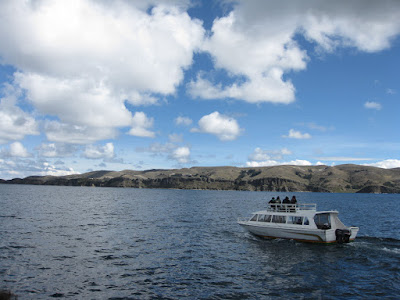
The next morning we took an 8:30 boat out to Isla del Sol. Most of the boats that go over are old lake cruisers which can be pretty slow, but the scenery was great from where we were sitting on top of the boat. The boat heads to the south part of the island to the town of Yumani first to drop off some people, then heads over to the north part of the island to the town of Cha'llapampa. The trip to the north takes about 2 hours. We decided to stay in Cha'llapampa for a night, then hike over to the south the next day.
 |
|
We loved to north part of Isla del Sol. It was very mellow, and besides a few small hostels and restaurants just seems like a small Bolivian town where people are going about their daily lives. We asked some girls who were leaving on the boat back about the Hostel they stayed at, and they told us they loved a small place called Hostel Cultural. The town is super small, so we found it right away. It was pretty funny because the parents were off somewhere else on the island, so we were negotiating with their six year old daughter regarding the price! We were surprised how cheap it was, as most islands have higher prices than the closest coastal city. Our private room with shared bath was 30 Bolivianos (about $4.28) and we had a great dinner of soup, spaghetti and trout with a bottle of wine for about 50 Bolivianos (about $7).
We spent first day in Cha'llapampa by hiking over to nearby Cha'lla and checking out the numerous animals that live on the beach including a ton of pigs and their piglets who live on a diet of lake weeds.
Then while watching the Lake, we saw a group of island kids who lost their ball, and were trying to get it off a thatched roof. Seeing the kids trying to climb up to try and retrieve it and almost falling compelled Jim to assist. The kids were super appreciative, and enthusiastically thanked Jim for the help!
That night and into the morning there were torrential rains, so we waited the rain out a little before making the trek to the south. When heading up the trail, there is a 10 Boliviano per person trail fee which we paid and went to the Inca ruins. The north side has the Rock of Creation which is the legendary Inca creation site and birthplace of the sun in Inca mythology.
We then headed the six kilometers, which went up and down the hills to the south. About a kilometer before the town of Yumani there was another ticket station! It was only 10 Bolivianos a person, but it got us a little annoyed as we thought we had already paid to be on the trail. But we paid it and kept going. What really got us was the THIRD place you had to pay to just get into the town of Yumani. An Argentinean couple almost got in a fight with guy at the third ticket station because it just seemed like we were getting constantly nickled and dimed, and that we had already paid for the trail. It was not much to pay, but everyone we met was annoyed with the system of three different places where you have to pay for one trail.
When we arrived in Yumani we had planned on staying the night there too. However Yumani is a lot different than Cha'llapampa as it is much more touristy with hostels everywhere. It was quite expensive too and was about quadruple what we paid for our room in Cha'llapampa for just a dorm bed! So we decided to head back to Copacabana on the 3:30 boat. The Lonely Planet states that it is easiest to buy a one way ticket to the island and then another one way back as you may not find your boat company. However, we found that it would actually be more advantageous to buy both with the same company as the way back is double the price when you are on the island than if you had bought the round trip. Finding your boat company would not have been a problem at all.
Overall, Copacabana and Cha'llapampa were great spots to start our Bolivian adventure.


