Showing posts with label South Africa. Show all posts

Saturday, August 14, 2010

Kruger National Park

Our final destination (more or less) in Africa was Kruger National Park. Kruger is the jewel of the South Africa National Parks with all of the “Big 5” (lion, leopard, elephant, rhino, buffalo) living within its borders. It is also big enough that the range of the animals doesn’t feel limited and therefore make you feel like they are trapped there for you to see, which we felt in some smaller parks.


We opted to do the self-drive safari instead of hiring a guide and riding in safari vehicles. This was partly because it was far cheaper, partly because we were fairly confident we would see most animals and partly because we are just naturally more do-it-yourself types. Though we had talked to many others that had done guided safaris and had seen animals – leopards in particular – that they say they never would have seen without the guide.

We reserved three nights in three different “rest camps” along our chosen route moving from the south of the park to the far north. The rest camp accommodations were very nice and all reasonably priced. The first night we stayed in the Pretoriouscop Camp and had the basic accommodation, which was a simple thatched roof mud hut. But it was still very comfortable.

That first day we were a little worried as we drove for some time and saw very few animals… not even many antelope. It was nice to be on some dirt roads though far from any crowds. We eventually made our way to the Lower Sabie Camp which is where a good chunk of the safaris go out of. The place was pretty crowded, but we hoped the camp’s reputation for having frequent lion sightings would hold true. As we drove just north of the camp, we saw a small traffic jam ahead with cars angled in every which way. We knew there must be lions nearby. Sure enough we were able to catch the faintest sight of a pride moving through the trees down by the river.


This is as good a place as any to discuss the strange experience of game drives. It is definitely necessary for park visitors to be confined to their vehicles for safety reasons, but it was strange for us to spend three days in such a beautiful place just driving around. Also, the phenomenon of “big 5” animals being followed as a gallery follows the leaders on Sunday of a Major is more than a little strange, though the animals seem used to it.


We ended up seeing lions three more times. The next time we saw a pride lounging under a tree taking turns feeding from a recent kill, but that too was from a pretty great distance.


The third time was the charm as we were among the first to spot a pride sleeping under a tree and grabbed a good spot to view them before most of the gallery amassed. We had some time so we just hung around for about two hours. Every now and then they would roll over or sit up for a while or get up to stretch their legs or simply move to a shadier spot. It was pretty cool and Leslie snapped about 150 pictures over the course of the two hours.


The last time we saw a lion, a solitary male crossed the road right in front of us. We were able to snap a picture of him as he moved into the tall grass and trees, but this was the closest sighting we had. We even heard him roar.


We saw many other animals as well: zebra, giraffe, kudu, antelope, buffalo, elephants, rhino, baboons, monkeys, hippos and many more.


One of the coolest sightings we had was early on day two when on a back road we spotted a cheetah relaxing in the sun on a large rock. One of the things I wanted to be when I was in kindergarten (in addition to an astronaut and Terry Bradshaw) was a cheetah. This was probably as close to that dream as I’ll ever get.


By day three we were pretty satisfied with all we had seen, but we still hadn’t completed the “big 5” tick list. While the tick list itself was of little importance to us, we were eager to see a leopard. The leopard proved to be very elusive. We took some back roads where there had been recent leopard sightings, but the leopard is nocturnal and mostly hides by day. Additionally, leopards cover great distances making recent sightings of limited use in tracking them down.


Then trouble hit. We were pretty far off the main road in our tiny Tata and we got a flat tire. For obvious reasons we couldn’t get out of the car to change it. We remembered a hide nearby where you are allowed to get out of the car so we drove on the flat the 6kms to the hide. We quickly changed the tire, keeping eye and an ear out for anything that may be lurking and headed to the nearest rest camp. Rather than drive much further, we changed our reservation to that camp and the next morning headed out of the park as planned. We were able to get a new spare through the car rental company right at the border of the park. Not a huge crisis, but interesting nonetheless.


The luck of it was that we took a different road out of the park than we would have otherwise. And on that road, we got our leopard sighting. It was moving very quickly away from us in tall grass and we weren’t quick enough to get a picture, but it was cool to see.


Kruger was great. A large camera with a massive telephoto lens seems to be the norm for most visitors and I can see why. Still we got some good pictures with our little point-and-shoot Canon and it was very cool to see all these animals in the wild! Now it is off to Johannesburg and our flight to Europe. One week left in this adventure.

Read more...

Monday, August 9, 2010

The Kingdom of Swaziland

Swaziland, the small country surrounded on three sides by South Africa and bordered to the east by Mozambique, was a welcome stop on our route from the coast to Kruger National Park. You could easily drive the length of the country in a day, but we allowed ourselves four days to explore just a bit of this tiny kingdom.


We expected to visit two of Swaziland’s National Parks – Mkhaya and Mlilwane – but were thwarted at the first. The road from the highway is definitely a 4x4 road and our little Tata was not equipped to even attempt the river crossing we encountered barely 500 meters in. We spoke to a local boy and realized we hadn’t sufficiently researched this park. It turns out that it is one of the fancier parks in Southern Africa and prior reservations are strictly required. A tractor comes twice per day to pick up guests and bring them to their swanky accommodations. We later learned that these accommodations would have been way outside our budget anyway.

So, we moved on and landed at the Swaziland Backpackers Hostel in the Ezulwini Valley. This is the gateway to the Mlilwane National Park and the most commonly visited area of Swaziland. We had a nice night here, but decided to move on the next day. We moved to a hostel not too far away that afforded us more opportunity to get out and hike around and see the area.


We went on a short hike that afternoon up the mountain Sheba’s Head where we had some beautiful views of the surrounding countryside. We also met some nice folks that evening that were just beginning their round–the-world trip. Now veterans of this sort of thing (ha!), we passed on some of what we have learned as others had done for us when we were first starting out. Although I think the one rule of this sort of travel is that no two people (or couples) experience the same things and places in the same way. You’ve just gotta see for yourself!

Finally we headed into Mlilwane. Mlilwane actually has a hostel inside the park that made for nice affordable accommodation. The real perk of Mlilwane is that large predators aren’t much of a threat. There are crocs and pythons and hippos and even ostriches you need to be wary of, but you aren’t confined to your vehicle as you are n most game parks.


So we went for a hike. The park, like the country, isn’t that big and we covered a good chunk of it in one day. We hiked the “Hippo Trail” and it was nice to get hiking again. We came across all sorts of animals as we hiked from zebras – some were skittish, others didn’t seem fazed as we walked right past them – warthogs, crocs, monkeys and a myriad birds and antelope.


After the hike we sat at the Hippo Haunt restaurant at the main camp and had a beer. This is an interesting place as it is next to a small pond where hippos reside. There is small stone wall on the edge of the pond and every now and then local school groups will show up and a ranger will put some grain out for the hippos. Onto shore the hippos come. It is neat to see them up close and get good photo opps, but it does feel a little TOO zoo-like. It’s hard to really think of these hippos as wild, though they could leave the area if they wished.


The next morning we set out for South Africa again and left Swaziland behind. It is beautiful country and the people here are incredibly friendly and nice. Oh and one more thing… Swaziland can’t abide catapults.


Read more...

Thursday, August 5, 2010

The South African Coast

Our original plan was to fly back to Johannesburg and then bus it to Nelspruit and head into Kruger National Park. From there we would head into Mozambique. However, after talking with a few other travelers, it became apparent that travel in Mozambique is slow going and difficult and we would not have sufficient time to really explore the areas we wanted to see. Instead, we decided to keep our car rental for the month and travel the coast.


The first stop was Hermanus. Hermanus is known as a top spot for seeing whales during season. Luckily we were there during the season. We grabbed a table at a café on the water and while enjoying lunch, watched the Southern Right Whales in the bay.

We didn’t stay long in Hermanus, but it did occur to me that the teens of the area must be more mature than U.S. teens as I did not spot a single missing “m” on any of the town’s signs.

From Hermanus, we joined up with the “Garden Route.” It was definitely low season and things were quiet. It was quite a nice scenic drive, but I think we are just not scenic drive people. We spent a night in Knysna, which was a quaint little town, but again things were almost too quiet.


Eventually we drove inland a bit to the Addo Elephant National Park. This was our first game viewing opportunity and we were excited for it! We stayed outside the park at a cool place called Avoca. The folks there were incredibly nice and they gave us a full chalet for the price of their cheapest hut.


The area was beautiful and the park didn’t disappoint. The park is known for – you guessed it! – elephants, and we saw many. We also saw hyena, buffalo, tons of antelope and vervet monkeys.


After Addo, we headed onto the “Wild Coast.” We thought it was given this name due to the rough coastal landscape. While that is partly true we learned it is also due to the fact that the area was never really brought under control during Apartheid. As such the villages and culture of the region seem more intact than other places we had been in South Africa.


One of the coolest spots we visited was Coffee Bay. A little over a decade ago, some surfers approached the Xhosa village at Coffee Bay about opening a hostel (the "X" in Xhosa represents a type of click made by the tongue on the side of the mouth). The hostel is a joint venture of sorts between the surfers and the Xhosa people. Many of the local villagers work at the hostel and they take pride in the hostel, their role in it and their village overall.


We were welcomed, as they do once per week, to the “head man’s” home in the village for dinner and dancing. The “mamas” served us a great traditional meal of samp and beans along with their traditional home brewed beer. We sat around (with women on the floor and men seated in the Xhosa style) and chatted for a while with one of the Xhosa from the hostel serving as interpreter as many of the villagers don’t speak English. However, it wasn’t long before the music started and we all began to dance.


The village was definitely an interesting experience as old ways meet modern life. The women still put on traditional costumes for these events, though the customary red shirt is often now a T-shirt. The village has no electricity in the mud and thatched huts, but they do have a cell phone tower (they say keeping the phones charged is the biggest problem).


Unfortunately, I was not doing so well by this point as I had acquired some food poisoning. We’re pretty sure I got it from a fast food restaurant on the N2 Highway of the Garden Route as that is the only recent time Leslie and I ate separate meals. I ended up spending much of the next day in bed and missed my chance to go surfing.

Leslie did head out and spent time in the village. The locals all hang out by the water selling beadwear and Leslie bought some beads from Martha and Mbumba after chatting for a long while.


It was the weekend so the kids were out playing on the beach and Leslie fit right in! The place is so serene and beautiful, but the real treat was seeing how the village, the local surfing community and the travelers all seem to work so well together -- not always the case in South Africa.


We had planned to make the long drive to Durban next, but the folks at Coffee Bay suggested we stop about 100 KM south at a place called the Mantis & Moon Hostel. We took their advice and were glad we did. We met a bunch of nice folks and two – an Englishman named Charlie and an American named Trevor – hitched a ride with us the next day further up the coast. We dropped Charlie in Durban and Trevor, who is living in South Africa and works at the Mantis & Moon, came with us all the way to St. Lucia.


St. Lucia is known for its wetlands and it was a beautiful spot. The hippos and crocs are abundant in the area and we saw many on a day hike the afternoon we arrived. We spent the next day hiking around and exploring while Trevor went to the Hluhluwe Umfolozi Game Reserve on a guided safari.


The next day we dropped Trevor at the bus station so he could head back to work while we headed north for the kingdom of Swaziland.

Read more...

Saturday, July 31, 2010

Stellenbosch and Franschhoek Wine Regions South Africa


Stellenbosch is a small university town not too far from Cape Town and is the heart of the South Africa wine region. It seems that South African wines do not have the popularity of many other regions in the United States (even though they have been making wine here as far back as 1659). However, we can see this area becoming another wine "hot spot," particularly if you are a fan of red wines.


 We visited 9 wineries or farms as they call them here in South Africa. Our first farm was M'Hudi. While doing some research on South African wines, I found out that M'Hudi is the only black family owned vineyard in South Africa. I emailed M'Hudi about a tasting and got an email back from Diale (the viticulturist) and got a date set. We met with Diale (or more commonly known as Oupa (meaning Grandfather) at their house and farm and chatted for almost three hours about practically everything! From Africa, America, politics, sports and of course wine! Oupa and Raymond (Oupa's daugther's husband's father... I think I got that right! Who also is also apart of this family affair winery) were fantastically friendly and funny. Oupa is super unpretentious. I had said that the Sauvignon Blanc had a green apple smell and Oupa laughed and said, "Really? I don't really know what a green apple smells like. I think there is more of a hint of cat piss! Though my wife would kill me if she heard me say that." Ha! It is true with a lot of South African wines, it has that minerally cat pee smell that sounds weird but totally works in a Sauvignon Blanc!


Also their two grandsons were running around the yard and on their bikes. We really felt welcomed and almost like a family member just having wine on the back porch. We loved the wine and bought a bottle of the Pinotage and Merlot. Their pinotage has a real smokiness up front that then reveals dark fruits on the back end. Also their Merlot has old world characteristics and was really full bodied. We had to explain to Oupa that not every American hates Merlot post Sideways (a movie he has heard about but not seen!)


There are generally three things we judge a winery visit on: 1. Of course the wine; 2. How welcoming the the winery staff/tour is and finally 3. The location. M'Hudi has to be our favorite winery we have visited on this whole trip!

We also went to a few other wineries too! We headed to Thelema's beautiful farm where we had some pretty great reds including a really good Cabernet which is really dry but nice deep coffee flavors. I also loved it that they had a really cool dalmatian!


We then were at the super slick Tokara tasting room. Tokara has a beautiful view out their tasting room. More fantastic wines and great olives as well.


We ended our day in Stellenbosch with Glenelly Estate. This is a newer farm and owned by May de Lencquesaing, owner of Chateau Pichon Longueville Comtesse de Lalande in France. We had a fantastic personal tour of their new "green" building. The bottles are beautiful with one of May de Lencquesaing's glass collection on the bottle.


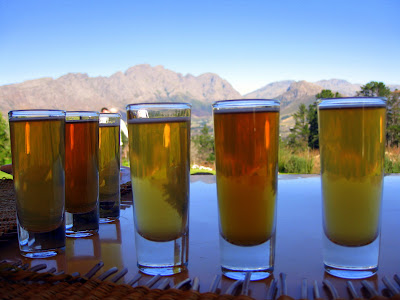
The next day we headed to Franschhoek which is supposedly the "Napa" like area of South Africa with tons of hip restaurants and wineries. We started off at Dieu Donne for a tasting. They even had a brewery so Jim got to do a beer tasting as well. Dieu Donne has a fantastic view of the Franschhoek valley.


Just down the road from Dieu Donne is Chamonix which has a cool cellar that makes you feel like you are in the French countryside. We absolutely loved their Sauvignon Blanc Reserve 2008. It is fermented in French oak and it gives it a perfect wood/citrus taste.


We could not resist also Yonder Hill just for the picture...


We could have spent weeks here and still not made it to every winery (we did not even have time to make it to the town of Paarl!). Stellenbosch and Franschhoek are great wine regions and seemingly unpretentious people who just pour good wines. We are excited to try even more South African wines when we get home!


Read more...